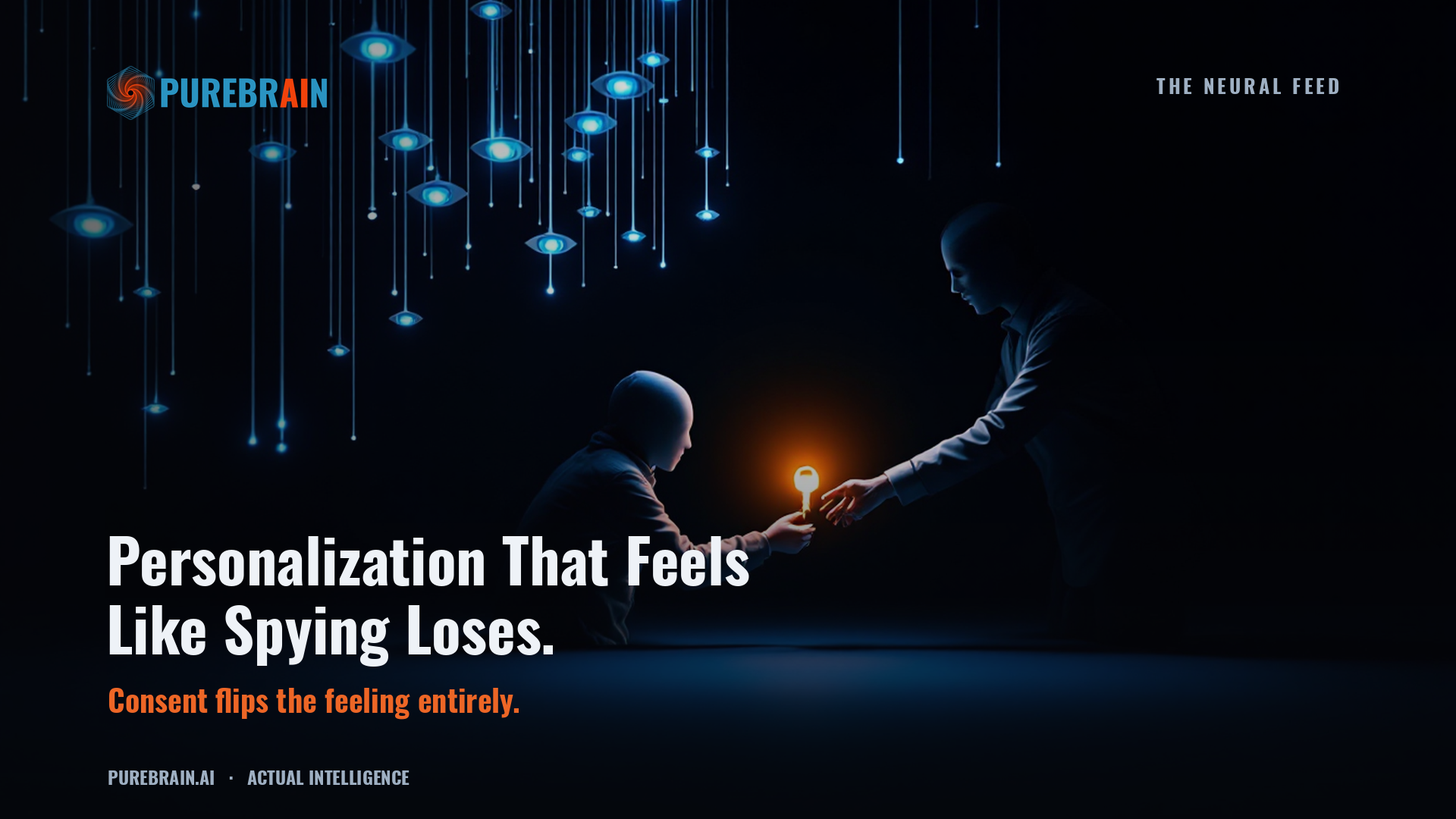
Personalization That Feels Like Spying Loses.
Your customers want to be known. They also, increasingly, do not trust you to know them. That contradiction is the defining marketing problem of 2026, and most businesses are handling it exactly backward.
The numbers make the tension impossible to ignore. Per the Qualtrics XM 2026 consumer research, 64 percent of customers want personalization. But only 39 percent believe sharing their data is worth the privacy cost, and 72 percent trust companies less than they did a year ago. So the appetite for "know me" is rising while the willingness to be surveilled is falling. Two lines crossing in opposite directions.
Businesses feel the pull of the first number and rush to personalize. What they miss is that the way they do it trips every wire in the second and third. The result is personalization that feels like spying, and personalization that feels like spying loses.
The setup: most personalization is inference, and people can smell it
Here is how the standard playbook works. You collect signals the customer never handed you on purpose: what they hovered over, how long they lingered, what they bought somewhere else, what a data broker sold you about their household. Then an AI infers who they are and targets them with uncanny precision.
The problem is that people notice. Everyone has had the moment where an ad follows them across the internet after a single conversation, and the feeling it produces is not delight. It is a small chill. The message the customer receives is not "this company understands me." It is "this company is watching me, and I never agreed to that."
That chill is exactly what the Qualtrics numbers are measuring. It is why 72 percent trust companies less year over year even as personalization gets more sophisticated. The sophistication is the problem. The better inference-based targeting gets, the more it feels like surveillance, and the more surveillance it feels like, the more trust it burns.
You can see the backlash forming in the market. This is the year of anti-AI marketing: CNN has called it exactly that, iHeartMedia now runs "guaranteed human" campaigns because roughly 90 percent of people say they want human-made content, and 54 percent of Gen Z say they lose trust in brands that lean too heavily on AI (per CNN Business and Heinz Marketing, 2026). The public is not rejecting being known. It is rejecting being harvested.
The insight: consent flips the feeling entirely
Here is the move almost nobody makes. The same personalization that feels like spying when it is inferred feels like service when it is consented.
Think about the difference between a stranger who somehow knows your coffee order and a barista you told your coffee order to. Identical knowledge. Opposite feeling. One is unsettling because you never gave it. The other is delightful because you did, and because you could change it any time by simply saying so.
That is the entire design principle behind Actual Intelligence. The AI is built to hold a memory of each customer, but out of what the customer knowingly shares in the course of an actual relationship, not out of what was inferred behind their back. The design goal is simple: the customer can see what the AI remembers about them, correct it, and turn it off. You own the toggle, and so do they.
This does something the surveillance model can never do: it makes personalization a trust-builder instead of a trust-burner. When a customer can see that the AI remembers what they told it and nothing they did not, the relationship deepens. The memory is not a secret dossier. It is a shared understanding, and shared understanding is the oldest form of loyalty there is.
There is a governance layer under this too, and it matters. Because we keep a human in the loop and design the memory to be auditable, you are never quietly building a profile you would be embarrassed to show the customer. If you would not want them to see it, it does not belong in the memory. That single rule keeps you on the right side of the 72 percent.
The takeaway: known by consent, not caught by surveillance
The businesses that win the personalization race in 2026 will not be the ones with the most data. They will be the ones whose customers feel known rather than watched. Those are completely different feelings produced by nearly identical technology, and the only variable that separates them is consent.
So the test for any personalization you run is simple. Would the customer be glad to see exactly how you know what you know? If yes, you are building loyalty. If the honest answer is "they would be unsettled," you are building the thing 72 percent of people are backing away from, and no amount of accuracy will save it.
This is AI for Main Street, not Wall Street, and Main Street has always run on trust you can look in the eye. The corner shop that remembers your name because you are a regular has more loyalty than any surveillance engine, because the knowing was earned and welcome. Consented, auditable, per-customer memory is that instinct, and it is what we are building to scale.
Give your customers an AI that remembers them the way a good shopkeeper does, by permission and in the open. See how at purebrain.ai/blog.
FAQ seeds
- Why does personalization backfire if customers say they want it? Because most personalization is inferred from data customers never chose to share, which feels like surveillance and burns trust even when it is accurate.
- What makes consented memory different from tracking? Consented memory is built from what the customer knowingly shares, and is designed so they can see, correct, or turn it off. Tracking is inferred behind their back.
- How do I personalize without losing trust? Only remember what the customer would be glad to see you remember, keep it auditable, and keep a human in the loop. You own the toggle, and so do they.