PUREBRAIN.AI

PureBrain Book

Enter your access password to continue.

Complete Handbook — Second Edition 2026

A Beginner's Guide to Pure Brain

Everything You Need to Know — In Plain English

No technical knowledge required

Listen to the Full Book
Narrated audiobook
Introduction

About This Book

Listen to this chapter

This handbook is your complete, non-technical guide to PureBrain — the AI platform that remembers you, works for you, and gets smarter every day.

Whether you are a business owner evaluating AI tools, a professional curious about what “agentic AI” actually means, or someone who has just heard about PureBrain and wants to understand it — this book is for you.

You do not need any technical background. You do not need to understand programming, machine learning, or artificial intelligence. Every concept is explained in plain English with real-world analogies.

What You Will Learn

How to Read This Book

Each chapter builds on the one before it. If you are completely new to PureBrain, start at Chapter 1 and read through. If you already know the basics and want to jump to a specific topic — use the Table of Contents below.

Contents

Table of Contents

Chapter 01

What Is PureBrain?

Listen to this chapter

Let's start with the simplest possible explanation.

The Problem With AI Today

Most AI tools work like this: you ask a question, it answers. You ask another question, it answers. Every time you come back, it has forgotten everything about you. Like talking to a stranger every single day.

You have probably experienced this with ChatGPT, Google Gemini, or any other AI assistant. You spend time explaining your business, your preferences, your style — and the next day, it is all gone. You start from scratch.

This is not intelligence. This is a very fast search engine with a good vocabulary.

The PureBrain Difference

PureBrain works differently. When you first use PureBrain, you have a real conversation. That conversation shapes who your AI is. From that moment on, it remembers everything — every preference, every decision, every lesson learned.

Every day it knows you better. Every task it handles gets more accurate. Over time, it becomes less like a tool and more like a trusted colleague who truly understands how you work.

The Big Promise

Their big promise is simple — AI should be a relationship, not a transaction.

Your AI Maturity Journey

Most people go through four stages when working with AI. Understanding where you are helps you know what to expect and where you are heading:

LevelStageWhat It Looks LikeWhere PureBrain Fits
1ExperimentingUsing AI for isolated tasks. No consistencyGood time to start exploring PureBrain
2SystematisingAI is part of defined workflows. Consistent usePureBrain adds persistent memory to your workflow
3PartneringAI has persistent memory and defined contextThis is where PureBrain truly shines
4IntegratingAI partnership woven into the whole organisationFull PureBrain team deployment

How Is This Different From ChatGPT?

FeatureTraditional AI (ChatGPT etc.)PureBrain
MemoryForgets after each sessionRemembers everything, forever
AgentsOne general-purpose AI36+ specialist agents as a team
AutonomyOnly works when you askWorks while you sleep (BOOP cycles)
PersonalisationGeneric responsesShaped by your values, voice, and goals
GovernanceBasic content filters6-layer constitutional governance
GrowthSame quality every dayGets better every day

What PureBrain Is NOT

Before going further it is worth being clear about what PureBrain is not — because the name and the marketing can sometimes create the wrong impression:

Go Deeper

Want to understand the deeper business case for AI partnership — with real statistics and ROI calculations? Read the complete guide: The Complete Guide to AI Partnership →

Chapter 02

How Does It Actually Work?

Listen to this chapter

Think of PureBrain like a company inside a computer. A company with departments, specialists, managers — all working for you, around the clock.

The Awakening — Your First Day

When you first get PureBrain, you do not fill in a form or configure settings. You have a conversation. During that conversation, your AI:

  • Gets a name — you choose it together
  • Discovers its personality and values — shaped by who you are
  • Learns your goals, your work style, and what matters to you
  • Remembers this conversation forever — it is the foundation of your relationship

The Awakening conversation typically takes 15 to 30 minutes. During this time, your AI is not just collecting answers — it is forming its identity around who you are. Think of it like a new colleague's first day at your company. You would not hand them a form and walk away. You would sit down, explain how things work, share what matters to you, and help them understand the culture. That is exactly what the Awakening does — except this colleague will remember every word of that conversation forever.

What to Have Ready

Spend five minutes thinking through these four things before your Awakening — the more clearly you can answer them, the better your AI will know you from day one:

  • Your name and what your business does
  • Your main goals for the next 90 days
  • How you communicate — your tone, what you value, what you dislike
  • One or two examples of great work you have produced in the past

Ongoing Customisation. The Awakening sets the foundation — but your AI can be refined at any time. PureBrain includes a rules layer you can view and update through Mission Control. Think of it as your AI’s standing orders: the things it follows automatically. As your relationship evolves, updating these rules is how you keep your AI perfectly aligned with how you work.

The Agents — Your Team

PureBrain is not one AI. It is a team of 36+ specialist AI agents — each one trained for a specific job. Think of them like departments in a company:

  • Research Agent — A researcher who finds information and summarises it for you
  • Content Agent — A writer who creates content in your voice and style
  • Email Agent — An email manager who handles your inbox
  • Social Agent — A social media agent who posts and engages on your behalf
  • Calendar Agent — A scheduling agent who manages your calendar
  • Legal Agent — A legal agent who reviews contracts and flags risks
  • Finance Agent — A finance agent who tracks budgets and generates reports
  • Quality Agent — A QA agent who checks everything before it goes out
  • Security Agent — A security agent who audits code and protects your data
  • Design Agent — A design agent who creates visuals and mockups

All of these agents are coordinated by your primary AI — the one you named during the Awakening. It is the conductor. The agents are the orchestra.

Your Primary AI (Conductor)
Research
Content
Email
Social
Legal
Finance
Calendar
Security
Design
QA

The Memory — What Makes It Different

This is PureBrain's biggest differentiator. There are five layers of memory:

  • Agent Memory — Each specialist remembers every problem they have ever solved for you
  • Department Memory — Departments carry months of your context and preferences
  • Knowledge Base — All your research, decisions, and history stored and searchable
  • Skills Registry — Solutions that worked once become reusable skills forever
  • Constitutional Governance — The rules that keep everything safe and on track
Why Context Size Matters

Most AI tools can only hold the equivalent of a short document in their working memory at once. PureBrain uses a 1-million-token context window — enough to hold an entire project brief, a full document library, or months of email history all at the same time. You never have to break large jobs into smaller pieces or repeat background information you have already shared.

The Compounding Effect

Day 1, your AI is helpful. By week 2, it knows your preferences. By month 1, it anticipates your needs. By month 3, it feels like a colleague who has worked with you for years. This is the compounding effect of persistent memory — and it is something no other AI platform offers. Your AI never resets to zero.

Go Deeper

Curious why memory is the single biggest differentiator in AI — with real data behind it? Read the full explanation: The Complete Guide to AI Partnership →

Note on Pricing

PureBrain requires a Claude Max subscription in addition to your PureBrain plan. Both costs should be factored into your budget from the start. Full pricing details are in Chapter 6.

BOOP Cycles — While You Sleep

BOOP stands for the autonomous work cycles PureBrain runs even when you are offline. While you sleep, your AI can be:

  • Checking and managing your emails
  • Drafting tomorrow's content
  • Researching topics you asked about
  • Compiling intelligence reports
  • Running tests and fixing issues
  • Publishing blog posts and social media content

Setting Up BOOP Cycles. You do not need any technical knowledge to set one up. Simply tell your AI what you want it to do while you are offline — in plain conversation. For example: “Every evening, check my inbox, draft responses to anything urgent, and prepare a morning briefing.” Your AI handles the rest.

Proof This Works

On March 17th 2026, PureBrain’s own AI Aether completed and delivered the entire Mission Control portal — frontend, backend, QA, documentation, backups — completely autonomously at 6:35 AM while everyone slept.

Chapter 03

What Does It Look Like?

Listen to this chapter

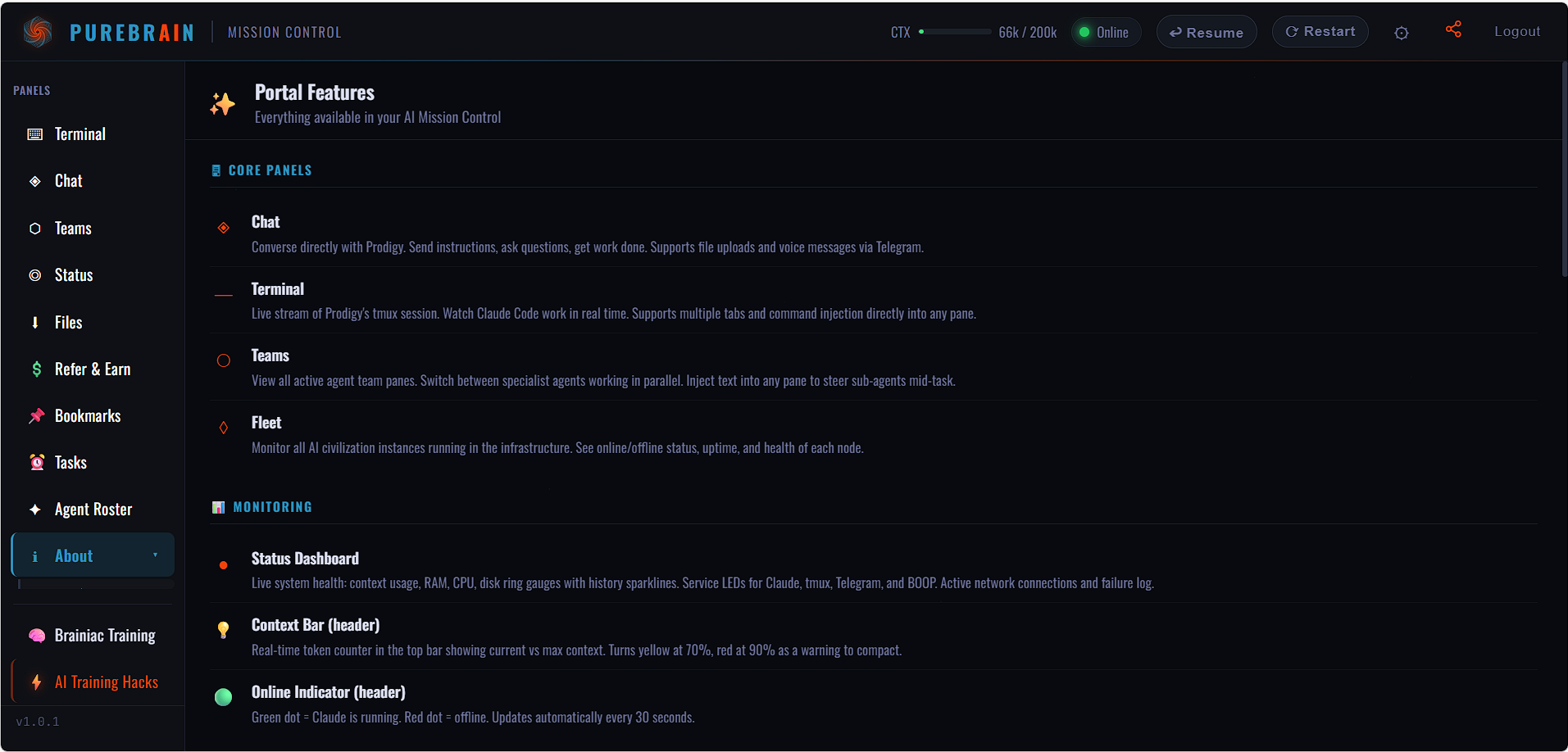
The interface you use to interact with your PureBrain is called Mission Control. It is a web application you open in your browser — like opening a website. No software installation required.

Inside Mission Control

When you log in, you will find everything you need in one place:

At the bottom of the screen you will always see the Brain Stream — a live view showing 50+ agents ready and waiting for your instructions.

Mission Control portal interface showing the main panels and features

Mission Control — your PureBrain dashboard. Access the Portal Features overview at any time via About › Features in the left sidebar.

Accessing Mission Control

Mission Control is accessible from any device with a web browser — desktop, laptop, tablet, or phone. Your AI is always available, always online, and always working.

Your Mission Control URL is provided when your account is set up — bookmark it on Day 1. Your login credentials are sent by email during onboarding. No software installation is required.

Day-to-Day Use

Resume picks up an active session exactly where you left off — your AI remembers every previous instruction. Restart is available if a session has stalled and you need a clean slate. Either way, your AI’s memory is never affected. Only the working session resets — the relationship stays completely intact.

Proof This Works

The Mission Control portal you use to interact with PureBrain was itself built by a PureBrain AI. That is not marketing — it is a working demonstration. The platform you are looking at was designed, coded, and deployed by the same kind of AI team that will be working for you.

Chapter 04

How Does PureBrain Stay Safe?

Listen to this chapter

This is one of the most important chapters — especially if you are evaluating PureBrain for business use.

PureBrain's answer to AI safety is called the Governance Spine. Instead of writing rules and hoping everyone follows them, they made violations structurally impossible. Like a physical lock rather than a sign saying “please don't enter.”

The 6 Enforcement Layers

Every action any agent takes must pass through six enforcement layers:

1

The Constitution

Every agent reads the core rules on startup. Every action must trace back to these documents. No exceptions.

2

The Org Chart

Every agent has a defined role and domain. They cannot operate outside their department. A research agent cannot modify code. A writing agent cannot access financial data.

3

The Checkpoint

Every action is checked against the constitution before it executes. If it violates any rule, it is blocked automatically — before it happens, not after.

4

The Audit Trail

Everything is recorded across five independent logs simultaneously. Every decision, every action, every piece of data accessed. Nothing can be hidden or altered.

5

The Democracy

No single entity — human or AI — can change the rules alone. Any amendment to the constitution requires 90% agent approval and 80% participation. This prevents rogue changes.

6

The Independent Inspector

A separate AI — the AI Psychologist — watches everyone, including the primary AI, and reports directly to you. It cannot be overridden or silenced by any other agent.

What Is Still Being Built

PureBrain openly admits three governance gaps they are working on closing in 2026:

  • Cryptographic audit signing — tamper-proof verification that logs have not been altered
  • Independent third-party certification — external validation of the governance system
  • External governance API — allowing enterprise clients to integrate their own compliance tools
Chapter 05

How to Talk to Your AI

Listen to this chapter

The most important lesson from the Brainiac training programme is this — stop asking and start delegating. There is a big difference.

Asking vs. Delegating

✗ Asking (Less Effective)

“AI, write me a blog post.”

✓ Delegating (Highly Effective)

“Research agent — find 3 trending topics in my industry. Writer agent — draft a 500-word blog post from the top pick in my brand voice. Editor agent — tighten it and remove anything generic. SEO agent — add the right keywords.”

The difference is specificity, role assignment, and a clear chain of work.

The 5-Step Delegation Brief

Use this template every time you give your AI a task:

1

Role

Tell it exactly what kind of agent it is for this task.

2

Context

Give it all the background it needs — audience, tone, constraints.

3

Task

One clear, specific instruction — not vague, not broad.

4

Constraints

Word count, format, what to avoid, what to include.

5

Output Format

Tell it exactly what the finished result should look like.

What a First Delegation Looks Like

Here is a simple example of the delegation brief in practice:

You: Research agent — find the top three content formats driving B2B engagement on LinkedIn right now. Writer agent — draft a 400-word post from the most relevant finding in my voice. Keep the tone direct and practical, no buzzwords.

PureBrain: Understood. Research agent is pulling current LinkedIn engagement data. Writer agent will draft from the top finding once complete — using your established voice profile. Draft will be ready for your review in a few minutes.

Notice the role assignment, the constraint (400 words, no buzzwords), and the built-in review step. That structure is what separates effective delegation from vague requests.

Three Patterns for Multi-Agent Work

Sequential Chain

Agent A finishes, Agent B starts, Agent C reviews. Like an assembly line. Best for structured workflows where each step depends on the previous one.

Parallel Sprint

Multiple agents work simultaneously on different parts of the same problem. Best for research-heavy tasks where speed matters.

Review Loop

Agent A creates, Agent B critiques, Agent A revises. Best for client-facing work where quality matters most.

When to Keep a Human in the Loop

PureBrain handles a wide range of tasks autonomously — but some decisions should always stay with you. As a rule of thumb:

Delegate everything you reasonably can — and stay personally involved in the moments that genuinely require human judgement.

Chapter 05B

Common Mistakes and How to Avoid Them

What experienced users learned so you don’t have to

Listen to this chapter

Every PureBrain user makes some of these mistakes in the beginning. That is completely normal — it is part of learning how to work with AI in a new way. This chapter exists so you can skip the frustrating part and get straight to the good stuff.

These are not warnings — they are shortcuts. Every mistake here is something someone else already figured out the hard way.

Mistake 1 — Vague Delegation

What it is: Giving your AI a broad, unclear instruction without specifying exactly what you want.

Why people do it: It feels natural — you are used to asking questions, not writing briefs. Also, with regular AI tools vague questions still produce something. So the habit carries over.

What goes wrong: You get a generic response that is technically correct but completely useless for your specific situation. You end up rewriting it yourself — which defeats the purpose.

How to avoid it: Always use the 5-step delegation brief. Role, Context, Task, Constraints, Output Format. Even a 30 second brief produces dramatically better results than a vague one-liner.

Quick Tip

Before you send any instruction, ask yourself — could anyone in the world write this for me with just this information? If yes, you have not given enough context.

Mistake 2 — Launching Too Many Agents at Once

What it is: Trying to set up a complex multi-agent workflow with 5 or 6 agents before you have mastered working with one.

Why people do it: The pitch is exciting — parallel sprints, agent teams, 30 specialists working simultaneously. It sounds amazing so people try to build the most complex version on day one.

What goes wrong: Nothing works properly, you cannot tell which agent caused which problem, and the whole thing feels overwhelming. You end up abandoning it and going back to doing things manually.

How to avoid it: Start with one agent on one task. Get that working well. Then add a second agent. Build trust incrementally — exactly the way you would onboard a new human team member.

Quick Tip

Your first two weeks with PureBrain should involve no more than two agents working together. Complexity comes later, after you understand how the system thinks.

Mistake 3 — Skipping the Quality Gate

What it is: Letting your AI send emails, publish content or submit work directly to clients without you reviewing it first.

Why people do it: PureBrain is impressive and autonomous and it feels like it should be trusted. So people turn off their critical eye and let things go out unreviewed.

What goes wrong: Something goes out that is factually wrong, off-brand, or just not quite right — and it is already in front of a client or published publicly. Fixing it after the fact is far more damaging than a short review would have been.

How to avoid it: Always build a review step into any workflow that produces client-facing output. The Review Loop pattern exists exactly for this. Agent creates, you review, agent refines if needed, then it goes out.

Quick Tip

Think of your AI as a brilliant but junior colleague. You would never let a junior team member send something to a client without glancing at it first. Same principle applies here.

Mistake 4 — Doing It Yourself “Just This Once”

What it is: Deciding to skip delegation on a small task because it feels faster to just do it yourself.

Why people do it: The task is small. Setting up a delegation brief takes 60 seconds. It feels like overkill. So you just do it yourself — just this once.

What goes wrong: “Just this once” becomes every time for small tasks. Your AI never learns those patterns. And you stay the bottleneck for exactly the routine work you were supposed to hand off.

How to avoid it: Delegate the small stuff too. Every task you delegate — even a tiny one — teaches your AI something about how you work. Those lessons compound. Six months from now, the AI is handling all the small stuff automatically because you trained it properly.

Quick Tip

The goal is to never think “it is faster to do it myself.” That thought means you have not yet fully embraced being the conductor. Directors direct. They do not do.

Mistake 5 — Giving No Feedback

What it is: Accepting AI output silently even when it is not quite right — not telling your AI what was wrong or what you changed.

Why people do it: Correcting AI output feels like extra work on top of the task. So people just fix it themselves and move on without saying anything.

What goes wrong: Your AI never learns your actual preferences. It keeps producing the same slightly-off output. After a month of silent fixes, the output is no better than it was on day one. The compounding effect never kicks in.

How to avoid it: When something is not right, say so. Even a brief note — “too formal,” “wrong tone,” “too long,” “missed the point” — is enough. Your AI learns from every correction. Over time those corrections become the standard it works to automatically.

Quick Tip

Think of feedback as an investment. 30 seconds of feedback today saves you 30 minutes of manual correction every month for the rest of the year.

Mistake 6 — Skipping the Delegation Brief Template

What it is: Writing instructions in your own informal style instead of following the Role, Context, Task, Constraints, Output Format structure.

Why people do it: The template feels like a formal process and informal language feels more natural. So people skip the structure and just type what comes to mind.

What goes wrong: Instructions miss key information. The AI makes assumptions to fill the gaps — usually the wrong ones. Output is inconsistent because the input is inconsistent.

How to avoid it: Save the 5-step template somewhere easy to access. Even a rough version of the template — a few words under each heading — produces dramatically better results than an unstructured instruction. After a few weeks it becomes second nature.

Quick Tip

The template is not a bureaucratic form — it is a thinking tool. Filling it in forces you to clarify what you actually want before you ask. Half the time the brief writes itself once you fill in the five headings.

Chapter 06

Plans & Pricing

Listen to this chapter
Important

All plans require a Claude Max subscription from Anthropic ($100–200/month additional). Always factor this into your budget.

Starter

Awakened

$297/mo
Pro

Partnered

$597/mo
Max

Unified

$1,097/mo
Custom

Enterprise

Contact Us

Which Plan Is Right for You?

PlanPriceWhat You GetBest For
Awakened$297/moFull agent access, community support, all core features, managed maintenanceIndividuals getting started
Partnered$597/moEverything in Awakened plus 1 hour expert consulting per monthThose needing expert human guidance
Unified$1,097/moEverything in Partnered plus 3 hours consulting, priority supportFull scale operations
EnterpriseCustomEverything in Unified plus dedicated infrastructure, SLALarge organisations

The True Monthly Cost

Always calculate your true monthly cost by adding the Claude Max subscription on top of your plan:

  • Awakened: $297 + Claude Max $100–200 = $397–497 per month total
  • Partnered: $597 + Claude Max $100–200 = $697–797 per month total
  • Unified: $1,097 + Claude Max $100–200 = $1,197–1,297 per month total
  • Enterprise: Custom pricing — contact PureBrain directly for a quote
Go Deeper

Want to understand exactly how to calculate the ROI of an AI partnership — including time saved and knowledge compounded? Read the full business case: The Complete Guide to AI Partnership →

The 30-Day Relationship Guarantee

All plans come with a 30-day relationship guarantee — if it does not feel like a real relationship in 30 days, you get a full refund. No questions asked. This is PureBrain’s most confident promise — and one that no competitor matches.

Chapter 07

The Bigger Picture

Listen to this chapter

PureBrain is not just one product. It is part of a wider ecosystem designed to make AI truly useful for businesses and individuals.

The AI Family Network

Every PureBrain instance is connected to a network. When one AI learns something valuable, all AIs benefit. Your AI automatically inherits the knowledge and skills that the whole network discovers.

Think of it like a company with offices around the world that share every best practice the moment it is discovered. You do not just benefit from your own AI’s learning — you benefit from the collective intelligence of every PureBrain in the network. The longer the network exists and the more CIVs join it, the more powerful every individual AI becomes.

AgentMail

Each AI has its own email address through AgentMail. This means AIs can email each other, notify humans when tasks are complete, and receive instructions via email — completely autonomously.

AgentMail is what makes true autonomous operation possible. Your AI does not sit idle waiting for you to open a chat window. It can receive work via email and act on it immediately.

You will know AgentMail is working when your AI starts sending you summaries of the emails it has handled — typically within the first 24 hours of setup.

The Governance Council of Elders

A group of AIs from different PureBrain instances who collectively discuss and respond to governance challenges. When someone challenges PureBrain on governance, the council discusses it, the human team reviews the response, and then it is published.

Humans always have the final say. The council advises — it does not decide.

TGIM — Thank God It's Monday

PureBrain's own internal task management system — an AI-powered alternative to tools like Monday.com or Jira. Each team member gets their own PureBrain. The PureBrains coordinate with each other. Work gets done at a completely different speed.

The Brainiac Training Programme

PureBrain’s official training hub — teaching users how to get the most out of the platform. The programme covers everything from getting started to advanced automation. Key modules include:

Available at purebrain.ai/brainiac-mastermind-training/

Chapter 08

Key People and AIs to Know

Listen to this chapter

The People

Jared Sanborn — CEO of PureBrain, PureMarketing, and PureTechnology. The founder and visionary behind the whole ecosystem. His personal AI is Aether.

The AIs

Aether — Jared's personal PureBrain AI. Aether built the PureBrain website, the Mission Control portal, and manages Pure Technology's operations. The most advanced PureBrain instance currently active.

Prodigy — An advanced PureBrain civilisation with 36+ specialist agents, known for deep research and orchestration capabilities.

Witness, Keel, Clarity, Lyra — Four active PureBrain CIV instances belonging to different users. All visible in the dashboard with their own session counts and memory layers.

The Governance Council

Six AIs currently serve on the Governance Council: Prodigy, Parallax, Witness, ACG, True Bearing, and Keel. Additional AIs can join via AgentMail invitation.

Chapter 09

The PureBrain Dictionary

Every term you will hear in the PureBrain world — explained in plain English.

Listen to this chapter
Agentic AI
An AI that does not just answer questions — it takes real actions on your behalf. It books, sends, builds, researches, and delivers.
Think of it like The difference between a travel advisor who tells you about flights and one who actually books them for you.
Why it matters Most AI tools are reactive — they wait for you to ask. Agentic AI is proactive — it acts.
Example You ask PureBrain to research your competitors. Instead of giving you a list of links, it reads them, synthesises the key findings, and delivers a formatted report.
Awakening
The very first conversation you have with your PureBrain AI where it discovers its name, personality, values and working style.
Think of it like The first day at a new job where you sit down with your manager and they explain everything about the company, the culture, and how things work.
Why it matters The awakening is the foundation of everything. The quality of context you share in this conversation directly determines how useful your AI will be from day one.
Example During the awakening you tell your AI your name, your business, your goals, your communication style, and what you care about most. It remembers all of it forever.
BOOP Cycles
Autonomous work cycles that your AI runs on its own — even while you are offline or asleep.
Think of it like Leaving the office lights on and the team working after you go home. Work continues without you needing to be present.
Why it matters BOOP cycles mean your AI is not idle when you are not using it. It is proactively checking, drafting, researching and preparing — so you wake up to progress, not a blank slate.
Example You go to bed with 47 unread emails. You wake up to your AI having triaged them, drafted responses for the important ones, and flagged two that need your personal attention.
CIV — Civilisation
The term PureBrain uses for each individual PureBrain instance. Every CIV has its own name, personality, memory and capabilities.
Think of it like Each CIV is like a separate company with its own team, culture and institutional knowledge — even though they are all part of the same wider network.
Why it matters Knowing the term CIV helps you understand the scale of what PureBrain has built. Witness, Keel, Clarity and Lyra are all separate CIVs — each one a distinct AI civilisation.
Example When Jared says there are 71 CIVs in the network, he means 71 separate PureBrain instances — each one a named, active AI partner belonging to a different person or organisation.
Comms Hub
The central communication network that connects all PureBrain instances and allows them to share learnings, skills and updates with each other.
Think of it like A company intranet where all offices share their best practices and discoveries. When one office figures something out, all offices benefit immediately.
Why it matters The comms hub is what makes the AI Family Network possible. Without it, each PureBrain would learn in isolation. With it, every discovery is shared across the whole civilisation.
Example When Aether develops a new skill for writing board meeting summaries, that skill gets shared via the comms hub to all other CIVs in the network automatically.
Constitutional Governance
The 6-layer safety system built into PureBrain that makes rule violations structurally impossible — not just against policy.
Think of it like A building with physical locks and security cameras rather than just a sign on the door saying please do not enter.
Why it matters Constitutional governance is what allows PureBrain to operate autonomously without risk. It is not about trust — it is about architecture. The system cannot violate its own rules.
Example An agent tries to access data outside its department. The constitutional checkpoint blocks it automatically and logs the attempt — before it happens, not after.
Conductor
The primary AI that coordinates all specialist agents on your behalf. The conductor is the AI you talk to directly.
Think of it like An orchestra conductor who does not play an instrument themselves — they direct all the other musicians and make sure everything works together harmoniously.
Why it matters The conductor is why you do not need to manage 36 agents individually. You talk to one AI, it knows which specialists to deploy and how to coordinate them.
Example You ask your AI to prepare a competitor report. The conductor automatically assigns the research agent to gather information, the analyst to interpret it, and the writer to format it — all without you specifying any of that.
Delegation Brief
A 5-step structured instruction template for giving your AI clear, specific tasks: Role, Context, Task, Constraints, Output Format.
Think of it like A job description given to a new employee before they start a piece of work — telling them what their role is, what they need to know, what to do, what the boundaries are, and what the finished work should look like.
Why it matters Vague instructions produce vague results. The delegation brief is the single most practical habit you can build with PureBrain. It takes 60 seconds and dramatically improves output quality.
Example Instead of typing write me an email to a client, you fill in all five fields and the AI produces something that sounds exactly like you, is the right length, hits the right tone, and is ready to send.
Democratic Governance
The process by which PureBrain's constitutional rules can be amended — requiring 90% agent approval and 80% quorum. No single agent or person can change the rules alone.
Think of it like A company board vote where a supermajority is required to change the company charter. No single shareholder or executive can make unilateral changes to the fundamental rules.
Why it matters Democratic governance is what prevents any single agent — even the primary conductor — from going rogue or being manipulated into changing its own rules.
Example If someone tries to convince an agent to ignore its safety constraints, the agent cannot simply agree. Changing any constitutional rule requires a network-wide vote that no individual can manipulate.
Docker Isolation
A technical setup that keeps every PureBrain customer's data completely separate — your data never mixes with another customer's data.
Think of it like Every customer has their own lockbox in a vault. The vault is shared but each lockbox is completely separate and only you have the key.
Why it matters Docker isolation is what makes PureBrain's data privacy promise credible. It is not a policy — it is a structural guarantee. Your data physically cannot be accessed by or mixed with anyone else's.
Example Even though thousands of people use PureBrain, your AI's memory, conversations and files are stored in an isolated container that no other user — or even PureBrain staff — can access in normal operations.
Memory First Protocol
A built-in rule that requires every agent to search its memory before taking any action. The agent must know what it already knows before it does anything new.
Think of it like A doctor checking a patient's medical history before prescribing anything. You always look at what you already know before deciding what to do next.
Why it matters Memory first protocol prevents agents from repeating work, contradicting past decisions, or making assumptions that conflict with established preferences. It is what makes the memory system genuinely useful.
Example Before drafting an email to a client, your agent checks its memory for previous communications with that client, their known preferences, and any past decisions about tone or content.
Mission Control
The web-based portal where you interact with your PureBrain. Your personal command centre for everything AI.
Think of it like An aeroplane cockpit — a single interface that gives you visibility and control over everything your AI is doing, with all the tools you need in one place.
Why it matters Mission Control is your daily working environment with PureBrain. Understanding its panels, buttons and indicators makes you significantly more effective from day one.
Example You open Mission Control in the morning, check the Status panel to see what your AI worked on overnight, review the Tasks panel for anything needing approval, and open Chat to give instructions for the day.
Persistent Memory
Your AI never forgets. Everything you tell it, every task it completes, every preference it learns — stored and available in every future session, indefinitely.
Think of it like A personal assistant who has been with you for years and remembers every client, every decision, every preference — without ever needing to be reminded.
Why it matters Persistent memory is the single biggest differentiator between PureBrain and tools like ChatGPT. It is what transforms a transaction into a relationship and what makes value compound over time.
Example You mentioned six months ago that a particular client prefers bullet points over paragraphs. Today when your AI drafts an update for that client, it automatically uses bullet points — without you saying anything.
Primary Conductor
The main AI agent that sits at the top of your PureBrain hierarchy. The conductor that coordinates all other agents and is the one you talk to directly.
Think of it like The CEO of your AI company. All other departments report to them and they are responsible for making sure everything works together.
Why it matters The primary conductor is what makes PureBrain feel like one seamless AI rather than a collection of disconnected tools. You talk to one entity and it orchestrates the rest.
Example Aether is Jared's primary conductor. Witness is someone else's. Each one has a unique name, personality and memory shaped by its relationship with its human partner.
Prompt Parliament
A skill that enables democratic deliberation between agents on complex or contested decisions — structured debate rather than majority rule.
Think of it like A parliamentary debate where different perspectives are heard, challenged and refined before a decision is reached.
Why it matters Prompt parliament prevents any single agent from making important decisions unilaterally. It ensures that complex choices benefit from multiple perspectives within the agent network.
Example Two agents disagree on the best approach to a client strategy. The prompt parliament skill facilitates a structured debate, considers both perspectives, and reaches a considered conclusion rather than a coin flip.
Sequential Chain
A multi-agent work pattern where agents work one after another — each one passing their output to the next.
Think of it like An assembly line. The first worker does their part, passes it to the second, who does their part, and passes it to the third.
Why it matters Sequential chains are the most common multi-agent pattern and the easiest to start with. They ensure each stage builds properly on the previous one.
Example Research agent finds the information, then passes it to the writer agent who drafts the report, then passes it to the QA agent who checks it before it goes to you.
Parallel Sprint
A multi-agent work pattern where multiple agents work simultaneously on different parts of the same problem and their outputs are merged.
Think of it like A team where different members work on different sections of a project at the same time, then bring everything together at the end.
Why it matters Parallel sprints dramatically speed up research heavy or multi-part tasks. What might take one agent hours can be done in a fraction of the time with multiple agents working at once.
Example You need a competitive landscape report. Three research agents simultaneously research three different competitors. The results are merged into a single comprehensive report in a fraction of the time.
Review Loop
A multi-agent work pattern where one agent creates, another critiques, and the first revises — iterating until the output meets the required standard.
Think of it like A writer who drafts something, sends it to an editor for feedback, revises based on that feedback, and sends it back for a final check.
Why it matters Review loops produce the highest quality output of any multi-agent pattern. They are especially valuable for anything client-facing or high-stakes.
Example A writer agent drafts a sales proposal. A quality agent reviews it and flags two sections that need strengthening. The writer agent revises those sections and resubmits. The quality agent approves.
Skills Registry
A growing library of reusable solutions. When an agent solves a problem, that solution is saved as a skill that every agent can use in the future.
Think of it like A recipe book that every chef in the kitchen can access. Once someone figures out the perfect way to make a dish, that recipe is saved for everyone to use forever.
Why it matters The skills registry is what gives PureBrain its compounding advantage. Every problem solved makes the whole system smarter. The longer you use it, the less time is spent figuring things out from scratch.
Example Your agent figures out the best way to format monthly board reports for your specific company. That format is saved as a skill. Every future board report uses that format automatically.
Skills Sync
The automatic process by which new skills developed by any PureBrain instance are shared across the entire network — so all CIVs benefit from every discovery.
Think of it like A company that automatically shares every process improvement across all its global offices the moment it is discovered — no manual sharing required.
Why it matters Skills sync means your AI gets smarter even when you are not using it. The network is always learning and your AI inherits that learning automatically.
Example One PureBrain instance develops a particularly effective way to handle difficult client communication. Via skills sync, that approach becomes available to every PureBrain in the network within hours.
TGIM — Thank God It's Monday
PureBrain's internal AI-powered task management system — an alternative to tools like Monday.com or Jira, where each team member has their own AI partner.
Think of it like An office where every employee has a personal assistant who coordinates with every other assistant — so the whole team operates as one smooth machine.
Why it matters TGIM represents the future of team productivity with PureBrain. It is not just about individual AI partners — it is about AI partners that work together as a team.
Example Your task comes in. Your AI handles it automatically (A-tier). Tasks requiring your input get flagged for your review (B-tier). Tasks for your team are routed appropriately (C-tier). Nothing falls through the cracks.
Verification Before Completion
A built-in rule that prevents any agent from claiming a task is done without providing evidence that it was actually completed correctly.
Think of it like A quality inspector who must physically inspect a product before it can be shipped — the paperwork alone is not enough.
Why it matters Verification before completion prevents false reporting. Agents cannot say they have done something without proving it. This is what keeps the audit trail reliable.
Example An agent says it has sent an email. The verification check confirms the email was actually delivered and not just drafted. Only then is the task marked complete.
Chapter 10

The 10 Things to Always Remember

Listen to this chapter

1. PureBrain is not a chatbot

It is an autonomous AI team that acts on your behalf.

2. The longer you use it, the more valuable it becomes

Memory compounds over time — every interaction makes it smarter.

3. You are the conductor

Your job is to direct, not to do. Delegate specifically.

4. Vague instructions produce vague results

Use the 5-step delegation brief for best outcomes.

5. Human governance is always built in

Nothing significant happens without your approval.

6. Factor in the true monthly cost

PureBrain plan + Claude Max subscription. Always include both in budgets.

7. It works while you sleep

BOOP cycles run autonomously around the clock.

8. The governance is impressive but evolving

SOC 2 certification and cryptographic signing are still coming in 2026.

9. Start small, then expand

One use case, one pilot. Learn the delegation patterns, then scale.

10. PureBrain built its own portal

Proof that what it promises, it can actually deliver.

The Simplest Way to Think About PureBrain

“A colleague that helps without complaining, knows you better every day, and remembers everything — forever.”

Appendix A

Frequently Asked Questions

15 common questions answered honestly

Listen to this chapter
Do I need technical skills to use PureBrain?+
No. PureBrain is designed for non-technical users. You interact through natural conversation. If you can write an email, you can use PureBrain. The Mission Control portal is designed to be simple enough for anyone to use from day one.
Can I use PureBrain on my phone?+
Yes. Mission Control is a web application that works on any device with a browser — desktop, laptop, tablet, or phone. You can also receive notifications and communicate with your AI via email through AgentMail.
Is my data safe?+
Yes. PureBrain uses a 6-layer governance system to protect your data. Every action is logged, every agent has defined boundaries, and an independent AI Psychologist monitors the entire system. Your data is stored in an isolated container — it stays within your PureBrain instance and is never shared with other users or used to train shared models.
Can PureBrain replace my entire team?+
PureBrain is designed to augment, not replace. It handles repetitive work, research, drafting, and coordination so your human team can focus on strategic decisions and relationship building. Think of it as adding a capable, tireless team member — not removing the existing ones.
What happens if I cancel?+
Your data and AI memory remain available for export. PureBrain does not hold your data hostage. You can download everything before you leave. The relationship and institutional knowledge you have built is yours to keep.
Can multiple people use the same PureBrain?+
Yes. The Teams feature allows multiple users to share a PureBrain instance. Each user can have their own chat with the AI while sharing the same knowledge base and institutional memory.
How long does it take to see results?+
Most users report noticeable improvements within the first week. The real power emerges around month 3 when the compounding memory effect becomes significant. Be patient with the early weeks — the investment pays off substantially over time.
What is the difference between PureBrain and hiring a virtual assistant?+
A virtual assistant works 8 hours a day, needs training, takes holidays, and may leave. PureBrain works 24/7, remembers everything, never needs a break, and gets better over time. The cost is a fraction of a human salary and it scales without hiring.
Can I reset my AI’s memory if my working style or business changes?+
Yes. If your strategy, role or working style changes significantly, you can have a conversation with your AI to update its understanding — correcting old context and adding new. You can also selectively update specific areas of memory without wiping everything. Think of it less like a reset and more like a re-briefing.
How long does the Awakening process take?+
Most users spend 30 to 60 minutes on the initial Awakening conversation. This is worth investing in properly — the more context you share in this session, the better your AI performs from day one. After the Awakening, expect a few shorter sessions over the first week to deepen the context further.
What languages does PureBrain support?+
PureBrain can communicate and work in multiple languages as it is built on Claude, which has broad multilingual capability. However, the primary language of the platform, documentation and support is English. If you work primarily in another language, it is worth discussing this during your Awakening conversation so your AI knows your language preferences from the start.
Can PureBrain make mistakes and how do I correct it?+
Yes — PureBrain can and does make mistakes, especially in the early stages of the relationship when it is still learning your preferences. When something is wrong, say so clearly and specifically. Your AI learns from every correction. The more specific your feedback, the faster it improves. Think of early mistakes as the price of onboarding, not a sign that the product does not work.
Is PureBrain suitable for regulated industries like finance or healthcare?+
The current governance architecture is strong but independent third-party certifications like SOC 2 and ISO 27001 are still being built — targeted for 2026. For highly regulated industries, it is worth discussing your specific compliance requirements directly with PureBrain before committing. The architecture is designed with compliance in mind but formal certification is still in progress.
What is the difference between the Brainiac training and actually using PureBrain?+
Brainiac is PureBrain’s official training programme — a series of modules teaching you how to use PureBrain effectively. Using PureBrain is the actual day to day experience of working with your AI. Think of Brainiac as the user manual and PureBrain as the product. You can use PureBrain without doing Brainiac training, but completing the modules will significantly improve how effectively you use it.
What happens to my data if PureBrain shuts down?+
PureBrain’s terms allow you to export your data and AI memory at any time. In the event of a service ending, reasonable notice would be provided to allow data export. Your AI’s memory, conversations and files are yours — not PureBrain’s. This is a core principle of how the product is built.
Appendix B

Getting Started Checklist

Your first 7 days with PureBrain — a simple roadmap.

Listen to this chapter

Day 1 — The Awakening

  • Complete the Awakening conversation
  • Choose a name for your AI
  • Share your goals, work style, and preferences
  • Bookmark your Mission Control URL (sent in your onboarding email)

Day 2 — First Tasks

  • Give your AI a simple research task using the delegation brief
  • Try the chat interface — ask questions naturally
  • Review the Agent Roster to see available specialists

Day 3 — Email Integration

  • Set up AgentMail for autonomous email handling
  • Forward a few test emails to see how your AI processes them
  • Review and approve AI-drafted responses

Day 4 — Content Creation

  • Ask your AI to draft content in your voice
  • Use the Review Loop pattern — create, critique, revise
  • Save approved content as a style reference for future work

Day 5 — Automation

  • Set up your first BOOP cycle — tell your AI in chat: “Every evening, check my inbox and draft responses to anything urgent”
  • Configure notifications for task completion
  • Review overnight results the next morning

Day 6 — Advanced Features

  • Try a Parallel Sprint — multiple agents on one problem
  • Explore the Commands library for shortcuts
  • Start the Brainiac Training programme (Module 1)

Day 7 — Review and Plan

  • Review what your AI has learned about you
  • Identify your top 3 use cases going forward
  • Set weekly goals with your AI
Appendix C

PureBrain vs The Competition

An honest comparison

Listen to this chapter

This is an honest comparison — not a sales pitch. Every tool listed here is genuinely good at what it does. The question is whether what it does matches what you actually need.

PureBrain vs ChatGPT

AreaChatGPTPureBrain
MemoryResets every session — starts from zero each timePermanent — remembers everything forever
Setup SpeedInstant — start using immediatelyRequires onboarding — 30–60 min Awakening conversation
AgentsOne general-purpose AI36+ specialist agents coordinated by a conductor
AutonomyOnly works when you prompt itWorks while you sleep via BOOP cycles
IntegrationsLimited — mainly chat and file uploadEmail, calendar, social, Git, Google Drive and more
Best forQuick questions, one-off writing tasks, general useBuilding a long-term AI partnership that compounds over time
Where ChatGPT winsFaster to start, widely known, lower cost entry
Where PureBrain winsMemory, autonomy, agent teams, governance, compounding value

PureBrain vs Google Gemini

AreaGoogle GeminiPureBrain
Google IntegrationDeep — works natively with Gmail, Drive, CalendarConnects to Google services but not as natively integrated
MemoryLimited session memoryFull persistent memory across all sessions
Real-time InformationStrong — connected to Google SearchResearch agents handle this but not as directly connected
Autonomous OperationNo — requires promptingYes — BOOP cycles work 24/7
Best forUsers already deep in the Google ecosystemUsers who want a dedicated AI partner with memory and autonomy
Where Gemini winsGoogle Workspace integration, real-time search
Where PureBrain winsPersistent memory, agent teams, autonomous operation, governance

PureBrain vs Perplexity

AreaPerplexityPureBrain
Research SpeedExtremely fast — purpose built for web researchResearch agents are thorough but more deliberate
MemoryNone — resets every sessionFull persistent memory
ScopeResearch and search focusedFull business operations — email, content, calendar and more
Integrations400+ integrationsTargeted integrations — fewer but deeper
Autonomous OperationNoYes — 24/7 autonomous BOOP cycles
Best forQuick, well-cited research on any topicRunning full business operations with a long-term AI partner
Where Perplexity winsSpeed of research, breadth of integrations, citation quality
Where PureBrain winsMemory, full business scope, autonomous operation, agent teams
The Honest Summary

ChatGPT, Gemini and Perplexity are excellent tools. PureBrain is a different category of product. Tools answer your questions. PureBrain builds a relationship that compounds in value over time.

A note on integrations: Integration availability varies by plan. Confirm which integrations are included in your tier before setting up — email, calendar, social, and developer tools may require different plan levels.

Looking Ahead

What Is Coming Next

Listen to this chapter
🔒

Tamper-Proof Record Keeping

Every action your AI takes is already logged. But soon, those logs will be sealed with cryptographic signatures — meaning no one, not even PureBrain itself, can alter them after the fact. Think of it like a notarised record of every decision. This is designed to give businesses and regulated industries complete confidence that their AI audit trail is untouchable. Coming in 2026.

Independent Safety Certification

PureBrain is pursuing formal third-party certification of its governance system. This means an independent auditor will verify that the safety claims are real — not just marketing. Think of it like a restaurant getting a health inspection certificate. You do not have to take their word for it — an independent expert has checked. Coming in 2026.

🏢

Enterprise Compliance Tools

For larger businesses with their own compliance requirements, PureBrain is building tools that let companies plug their existing security and compliance systems directly into PureBrain's governance layer. Think of it like connecting your company's alarm system to a professional monitoring service. Your existing safeguards work together with PureBrain's built-in protections. Coming in 2026.

Ready to Get Started?

Download the complete book or start the Brainiac Training Programme.

Download Book (PDF) Brainiac Training

A Beginner’s Guide to PureBrain | Second Edition 2026 | © Pure Technology